How to calculate your golf handicap (World Handicap System)
In 2020, the USGA and R&A rolled out the World Handicap System (WHS), a unified way to calculate
golf handicaps around the world. The math looks a little scary at first, but the idea is simple: your handicap should
reflect your potential on a good day, not your worst blow-up rounds.
On this page we’ll walk through how a Handicap Index is created, how each round turns into a Score Differential,
how to convert your Index into a Course Handicap, and what actually helps bring that number down over time.
For the official full details, see the USGA’s
Handicapping 101
.
Some links on this page are affiliate links. If you buy through them, we may earn a small commission at no extra cost
to you. It helps keep Reach The Green up and running.
What your Handicap Index actually is
A Handicap Index is basically your “potential” in number form. It’s not an average of all your scores,
and it’s not your personal best round either. Under WHS, it’s built from your best 8 Score Differentials
out of your most recent 20 rounds.
That means a few hot rounds will pull your Index down, but a random disaster trip to the woods doesn’t completely
wreck it. The system also has safeguards so your handicap doesn’t jump all over the place from week to week.
Getting an official Handicap Index
Join a club, course, or app that’s authorized to issue official handicaps.
Post scores for 54 holes (any combo of 9-hole and 18-hole rounds).
Once you have enough scores, the system crunches the numbers and gives you a starting Index.
After that, your Index updates daily when you post new rounds.
Why handicaps matter
They let players of different skill levels compete fairly.
You can set goals and track long-term progress, not just one hot round.
Many leagues, tournaments, and club games require an official handicap.
Step 1: how each round becomes a Score Differential
Every time you post an acceptable round, WHS converts it into a Score Differential. This adjusts
for how hard the course is and for the day’s conditions, so a 90 on a brutal layout might show up “better” than
an 88 on an easy one.
Adjusted Gross Score (AGS) – your score after applying WHS limits on max hole score and any rules adjustments.
Course Rating – what a scratch golfer (Index 0.0) is expected to shoot from those tees.
Slope Rating – how much harder the course plays for average golfers compared to scratch players (113 is “standard”).
PCC (Playing Conditions Calculation) – an adjustment the system makes if scores that day were unusually good or bad because of wind, rain, etc.
You don’t have to do this math yourself; your club or handicap provider handles it automatically. But understanding
the pieces makes it clear why course difficulty matters so much.
Step 2: from Score Differentials to Handicap Index
Once the system has enough Score Differentials for you, it sorts them from best to worst and averages the best ones.
With 20 rounds in your record, it uses your best 8. With fewer rounds, it uses a smaller sample.
Example: 20 scores posted
Let’s say you’ve posted 20 rounds. Each has a Score Differential.
Sort the 20 differentials from lowest (best) to highest (worst).
Pick the best 8 of those 20.
Average those 8 numbers.
That average (after some rounding and safeguards) becomes your Handicap Index.
Daily updates
Under WHS, your Index can update every day there are new scores posted. That means a really
good stretch of golf will show up fairly quickly, but the system won’t overreact to a single out-of-nowhere round.
There are also built-in caps to stop your handicap from drifting too far above your recent best (your “Low
Handicap Index”).
Step 3: turning Handicap Index into Course Handicap
Your Course Handicap is how many strokes you get from a specific set of tees on a specific course.
It adjusts your Index for that layout’s rating and slope, plus the par of that set of tees.
Plugging those in gives you a Course Handicap right around 17 strokes. On another course that’s
easier or harder, that number will change even though your Handicap Index stays the same.
Since your Handicap Index is based on your best rounds, the goal isn’t to play perfect golf every time.
It’s to make those “good days” a little bit better and a little more common. Practically speaking, that usually
means cleaning up the repeat mistakes:
Penalty shots – balls out of bounds or in hazards add up quickly.
Three-putts – a bad lag putt and a missed short one can wreck an otherwise solid hole.
Chunked or bladed wedges – especially inside 100 yards, where you’re supposed to be in scoring mode.
You don’t need tour-level stats to work on this. A simple notebook or note on your phone that tracks:
How many penalty shots you took.
How many times you three-putted.
How many “good looks” inside 10 feet you gave yourself with wedges.
If those numbers slowly trend the right direction, your best 8 Score Differentials will sneak lower, and your
Handicap Index will follow.
Training aids that support a lower handicap
You can absolutely lower your handicap with nothing but range time and a good plan. That said, a few simple training
aids can make practice more focused and give you clearer feedback on what’s working.
Below are some popular golf training aids pulled from Amazon and limited to the
top 10 by customer rating in our feed—mostly aimed at:
Improving putting speed and starting the ball on line.
Cleaning up swing path and contact to keep the ball in play.
Sharpening wedge and short-game feel around the greens.
As always, prices and availability change quickly. Click through to see current details, reviews, and specs.
A few standout training aids (by customer rating)
These are three of the highest-rated options from our top 10 list. They’re a nice starting point if you don’t
want to click through every product.
Training aid
Rating
Price*
Link
GolfForever Swing Trainer – Golf Training & Fitness System for Strength, Flexibility & Swing Power – Includes 30-Day Membership & Training Bar for Golf-Specific Workouts
*Approximate price shown from the feed. Always confirm the current price and options on Amazon.
Top 10 golf training aids by rating
GolfForever Swing Trainer – Golf Training & Fitness System for Strength, Flexibility & Swing Power – Includes 30-Day Membership & Training Bar for Golf-Specific Workouts
Rating: 4.4 ★
(426 reviews)
$139.99
$199.99
Click through for more details on how this training aid helps with alignment, contact, tempo, or putting.
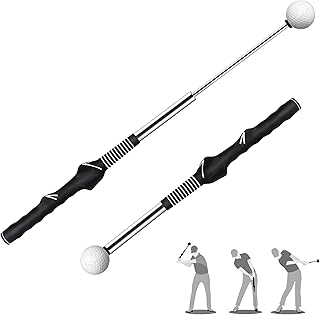
Retractable Golf Swing Training Aid,Rhythm Click Sound Warm Up Golf Swing Trainer,Golf Grip Trainer Attachment -Strength & Tempo Training for Chipping Hitting,Golf Accessories for Men
Rating: 4.2 ★
(185 reviews)
$19.49
$24.99
Click through for more details on how this training aid helps with alignment, contact, tempo, or putting.
6-in-1 Golf Training Aid w/Divot Board, Golf Grip Trainer, Swing Trainer, Alignment Sticks | Golf Accessories for Men & Women | Hitting Mat Practice Indoor & Outdoor
Rating: 4.8 ★
(26 reviews)
$54.95
Click through for more details on how this training aid helps with alignment, contact, tempo, or putting.
Golf Alignment Rods: Magnetic Club Alignment Stick Demonstrates Correct Golf Swing Aim, Golf Training Aid Magnet Lie Angle Tool Training Aids Visualize
Rating: 4.6 ★
(218 reviews)
$12.95
Click through for more details on how this training aid helps with alignment, contact, tempo, or putting.
WATSON | GOLF theHANGER™ Official Golf Training Aid, Golf Swing Aid Helps Golfers Achieve Clubface Control to Eliminate Hooks and Slices (Made in The USA)
Rating: 3.9 ★
(1128 reviews)
$64.95
$79.95
Click through for more details on how this training aid helps with alignment, contact, tempo, or putting.
Tip: pick one area tied directly to your handicap—like three-putts or penalty shots—and choose a single training aid
that helps you work on that, instead of buying a whole garage full of gadgets.
Golf handicap FAQ
What is the highest Handicap Index?
Under the World Handicap System, the maximum Handicap Index is 54.0 for both men and women.
Do 9-hole rounds count toward my handicap?
Yes. Two 9-hole rounds are combined into one 18-hole Score Differential. Just make sure you’re playing from rated tees
and following the basic rules for an acceptable score.
How often does my handicap update?
In most places, your Handicap Index updates daily on days when new acceptable scores are posted.
Do casual rounds with friends count?
Casual golf absolutely counts, as long as it’s played under the Rules of Golf, on a rated course, and you follow
your handicap provider’s guidelines for posting scores. It doesn’t have to be a tournament.
Can I track an unofficial handicap on my own?
You can manually approximate one using the ideas on this page, but most golfers are better off using an official
WHS-enabled service so everything stays in sync with club events and other golfers’ handicaps.